728x90
import numpy as np
import matplotlib.pyplot as plt
X = np.arange(-1.0, 1.1, 0.1)
Y = np.arange(-1.0, 1.1, 0.1)
input_data = []
correct_data = []
for x in X:
for y in Y:
input_data.append([x, y])
if y < np.sin(np.pi * x):
correct_data.append([0, 1])
else:
correct_data.append([1, 0])
n_data = len(correct_data)
input_data = np.array(input_data)#np.array(input_data)
correct_data = np.array(correct_data)
n_in = 2
n_mid = 6
n_out = 2
wb_width = 0.01
eta = 0.1
epoch = 101
interval = 10
class MiddleLayer:
def __init__(self, n_upper, n):
self.w = wb_width * np.random.randn(n_upper, n)
self.b = wb_width * np.random.randn(n)
def forward(self, x):
self.x = x
u = np.dot(x, self.w) + self.b
self.y = 1/(1+np.exp(-u))
def backward(self, grad_y):
delta = grad_y * (1-self.y)*self.y
self.grad_w = np.dot(self.x.T, delta)
self.grad_b = np.sum(delta, axis=0)
self.grad_x = np.dot(delta, self.w.T)
def update(self, eta):
self.w -= eta * self.grad_w
self.b -= eta * self.grad_b
class OutputLayer:
def __init__(self, n_upper, n):
self.w = wb_width * np.random.randn(n_upper, n)
self.b = wb_width * np.random.randn(n)
def forward(self, x):
self.x = x
u = np.dot(x, self.w) + self.b
self.y = np.exp(u)/np.sum(np.exp(u), axis=1, keepdims=True)
def backward(self, t):
delta = self.y - t
self.grad_w = np.dot(self.x.T, delta)
self.grad_b = np.sum(delta, axis=0)
self.grad_x = np.dot(delta, self.w.T)
def update(self, eta):
self.w -= eta * self.grad_w
self.b -= eta * self.grad_b
middle_layer = MiddleLayer(n_in, n_mid)
output_layer = OutputLayer(n_mid, n_out)
sin_data = np.sin(np.pi * X)
for i in range(epoch):
index_random = np.arange(n_data)
np.random.shuffle(index_random)
total_error = 0
x_1 = []
y_1 = []
x_2 = []
y_2 = []
for idx in index_random:
x = input_data[idx]
t = correct_data[idx]
middle_layer.forward(x.reshape(1,2))
output_layer.forward(middle_layer.y)
output_layer.backward(t.reshape(1,2))
middle_layer.backward(output_layer.grad_x)
middle_layer.update(eta)
output_layer.update(eta)
if i%interval == 0:
y = output_layer.y.reshape(-1)
total_error += np.sum(t * np.log(y + 1e-7))
if y[0] > y[1]:
x_1.append(x[0])
y_1.append(x[1])
else:
x_2.append(x[0])
y_2.append(x[1])
if i%interval == 0:
y = output_layer.y.reshape(-1)
total_error += - np.sum(t * np.log(y + 1e-7))
if y[0] > y[1]:
x_1.append(x[0])
y_1.append(x[1])
else:
x_2.append(x[0])
y_2.append(x[1])
if i%interval == 0:
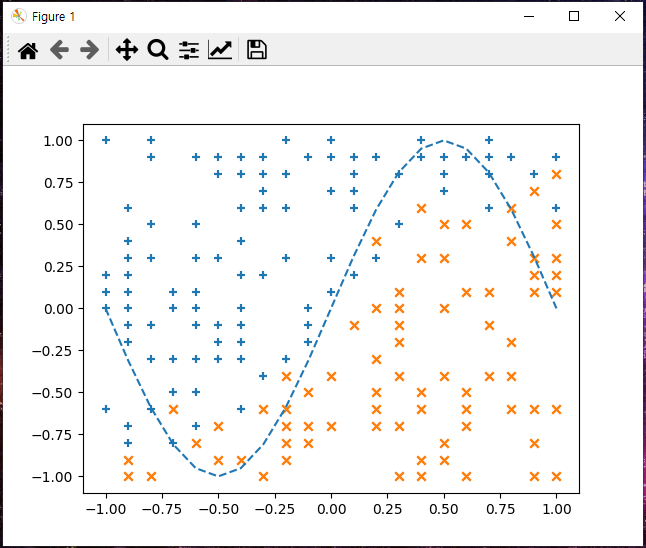
plt.plot(X, sin_data, linestyle="dashed")
plt.scatter(x_1, y_1, marker="+")
plt.scatter(x_2, y_2, marker="x")
plt.show()
print("Epoch:" + str(i) + "/" + str(epoch), "Error:" + str(total_error/n_data))
728x90
'AI(Artificial Intelligence)' 카테고리의 다른 글
| 과적합 테스트 (overfitting test) (0) | 2024.08.09 |
|---|---|
| [딥러닝] 주짓수 훈련과 복음 활동이 지능적 성장과 심리적 안정에 미치는 영향 분석 (0) | 2024.08.08 |
| pykakao (1) | 2024.07.22 |
| 신경망 각 층의 구현(분류) (1) | 2024.07.16 |
| 신경망 각 층의 구현(회귀) (1) | 2024.07.16 |


